
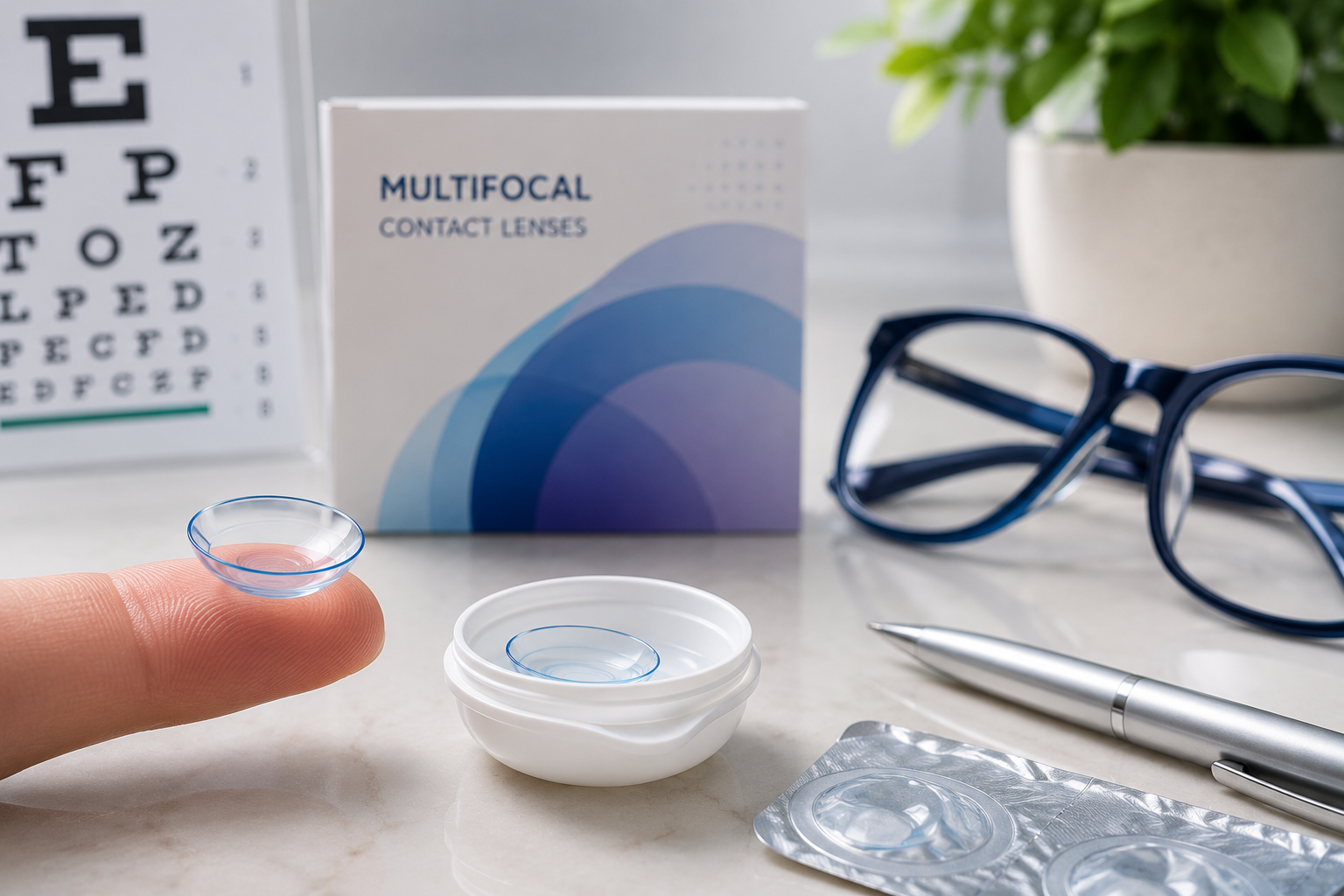
Multifocal Contact Lenses in Plano, TX: Custom-Fitted by a Fellowship-Credentialed Specialist
Hybrid contact lenses pair a rigid gas permeable center with a soft outer skirt for RGP-level clarity and soft-lens comfort fitted personally by Dr. Beth Summers in Plano for keratoconus, advanced astigmatism, and irregular corneas.
When Off-the-Shelf Multifocals Fall Short
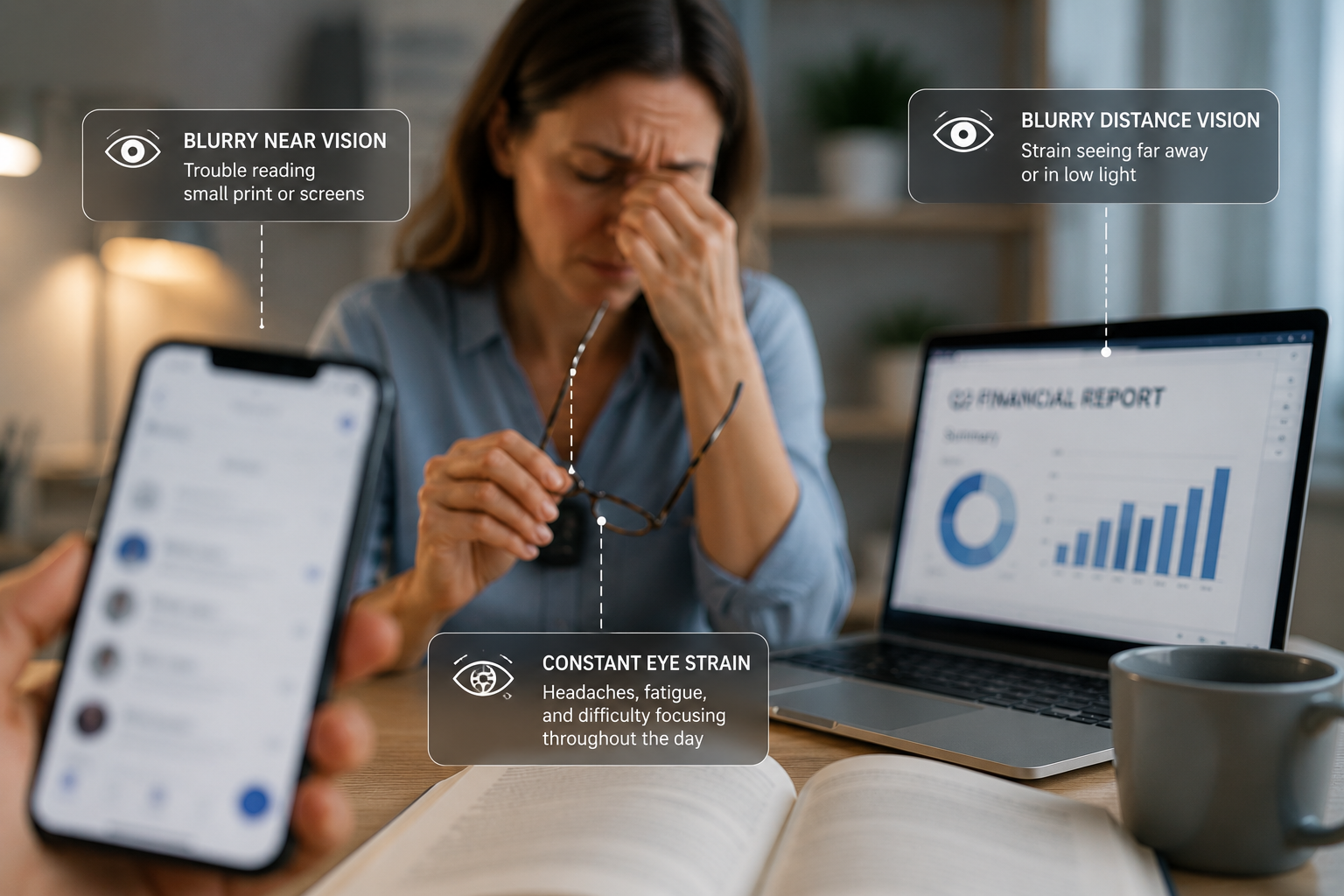
Most people try multifocal contact lenses for the first time at a general eye care office, and many walk away frustrated. Soft multifocal contacts from major manufacturers follow a generic optical design: they assume a standard corneal shape, a predictable pupil response, and an eye surface that tolerates the lens without complaint. When any of those assumptions are wrong, the result is blurry intermediate vision, glare around headlights at night, or lenses that simply never feel right.
For patients with any degree of corneal irregularity, dry eye, advanced astigmatism, or a history of refractive surgery, standard multifocals frequently fail entirely. Pushing forward with the wrong lens design wastes months of follow-up visits, generates unnecessary lens replacement costs, and leaves patients settling for reading glasses they were trying to avoid.
The right fit, done precisely from the start, eliminates that cycle.
Reduced adaptation time: A lens mapped to your actual corneal geometry typically reaches comfortable, stable wear in days rather than months of trial and error.
Sharper vision across all distances: Custom optical zone placement accounts for your specific pupil size and light response, which generic lenses cannot do.
Avoided compounding costs: Accurate diagnostics at the first appointment prevent repeated emergency refits, replacement lens fees, and the hidden cost of lost productive time.
A typical scenario at this practice: a patient in their mid-fifties with early dry eye and mild post-LASIK corneal flattening had tried two commercial multifocal brands over eighteen months with no success. After corneal topography mapping and a custom soft multifocal fitting designed around the altered corneal profile, stable, comfortable vision at all distances was achieved within two follow-up visits.
What to Expect: The Multifocal Contact Lens Fitting Process at Texas Contact Lens Institute
Step 1: Advanced Corneal and Ocular Surface Imaging
Before any lens is selected, Dr. Summers uses corneal topography and ocular surface analysis to map the precise shape, elevation, and surface health of your eyes. Standard multifocal fitting charts used at most offices cannot capture the individual corneal irregularities, surface dryness patterns, or pupil dynamics that determine whether a specific multifocal design will actually work. This imaging step, performed at our Plano clinic, takes approximately 30 to 45 minutes and forms the entire basis for the lens design that follows.
Step 3: Refinement and Verification
Most multifocal fittings require one to two follow-up visits after the initial trial to verify that vision is stable and the lens is performing correctly under varied lighting. This is not an open-ended process: Dr. Summers works from a documented refraction and imaging baseline, so each follow-up is a targeted verification against measurable parameters, not a guess-and-check session.
Step 2: Custom Lens Engineering and Trial Fitting
Using the diagnostic dataset, Dr. Summers selects or custom-orders a lens design matched to your corneal geometry, add power requirements, and ocular surface tolerance. A trial fitting is conducted in the office so that vision quality, centration, and comfort can be evaluated under real lighting conditions, including the distance and near tasks you actually rely on every day. Adjustments to optical zone size, base curve, and material are made before any final lens is ordered.
Step 4: Co-Managed Care with Your Primary Eye Doctor
Texas Contact Lens Institute functions as a specialty fitting practice, not a full-scope optometry office. Once your multifocal lens is finalized and stable, you return to your referring eye care provider in the Plano or DFW area for routine annual exams. Ongoing lens health checks and refits for prescription changes are managed here as needed through scheduled appointments.

What to Look for Before Choosing a Multifocal Contact Lens Provider in Plano
Multifocal contact lens fitting is one of the most technically demanding services in optometry. Not every optometry office has the equipment or specialist training required to do it well, especially for patients with complicating factors. Before booking anywhere, consider the following:
Fellowship-level credentials in specialty lens fitting: The designations FAAO (Fellow of the American Academy of Optometry) and FSLS (Fellow of the Scleral Lens Education Society) indicate documented, peer-reviewed expertise in complex contact lens design. Ask any provider you consider whether their fitting optometrist holds either credential.
Diagnostic imaging, not just a slit-lamp exam: Corneal topography is the standard of care for any patient with irregular astigmatism, prior refractive surgery, or dry eye disease. A provider who skips this step is designing your lens without the most important data.
A documented refitting policy: Understand upfront what happens if the first lens does not perform. Practices with transparent follow-up protocols, rather than open-ended charges per visit, protect you from a potentially expensive trial-and-error process.
Experience with your specific complicating factors: Presbyopia combined with dry eye, post-LASIK corneal changes, or moderate astigmatism requires a practitioner who handles these cases regularly, not occasionally.
Clear communication about costs before you commit: Specialty multifocal fittings involve diagnostic fees, trial lens costs, and final lens orders. Any practice worth your time will walk you through what the process involves before your first appointment.
What Do Multifocal Contact Lenses Cost in Plano, TX?
The cost of a multifocal contact lens fitting varies meaningfully based on the complexity of your eyes, the type of lens required, and the number of fitting visits needed to reach a stable result. Several factors drive the final investment:
Lens design type: Custom soft multifocals, custom toric multifocals for patients with astigmatism, and specialty multifocal sclerals are priced differently because the manufacturing process, materials, and fitting time differ significantly.
Number of diagnostic and fitting visits: Eyes with complicating factors such as corneal irregularity or dry eye disease typically require more fitting sessions than healthy, straightforward presbyopia cases.
Ocular complexity: Patients with a history of LASIK, RK, PRK, or cataract surgery often require custom lens parameters that fall outside standard manufacturing ranges, which affects both design time and lens cost.
Ongoing replacement and follow-up needs: Annual lens replacement and periodic prescription verification are part of the long-term cost picture for any multifocal wearer.
Texas Contact Lens Institute does not bill insurance directly and is an out-of-network provider. A complete medical superbill is provided on request after the fitting is complete, which you can submit independently to your insurer for potential reimbursement. Specialty lens consultations are free of charge. Call or text (972) 299-8675 for current pricing specific to your case.

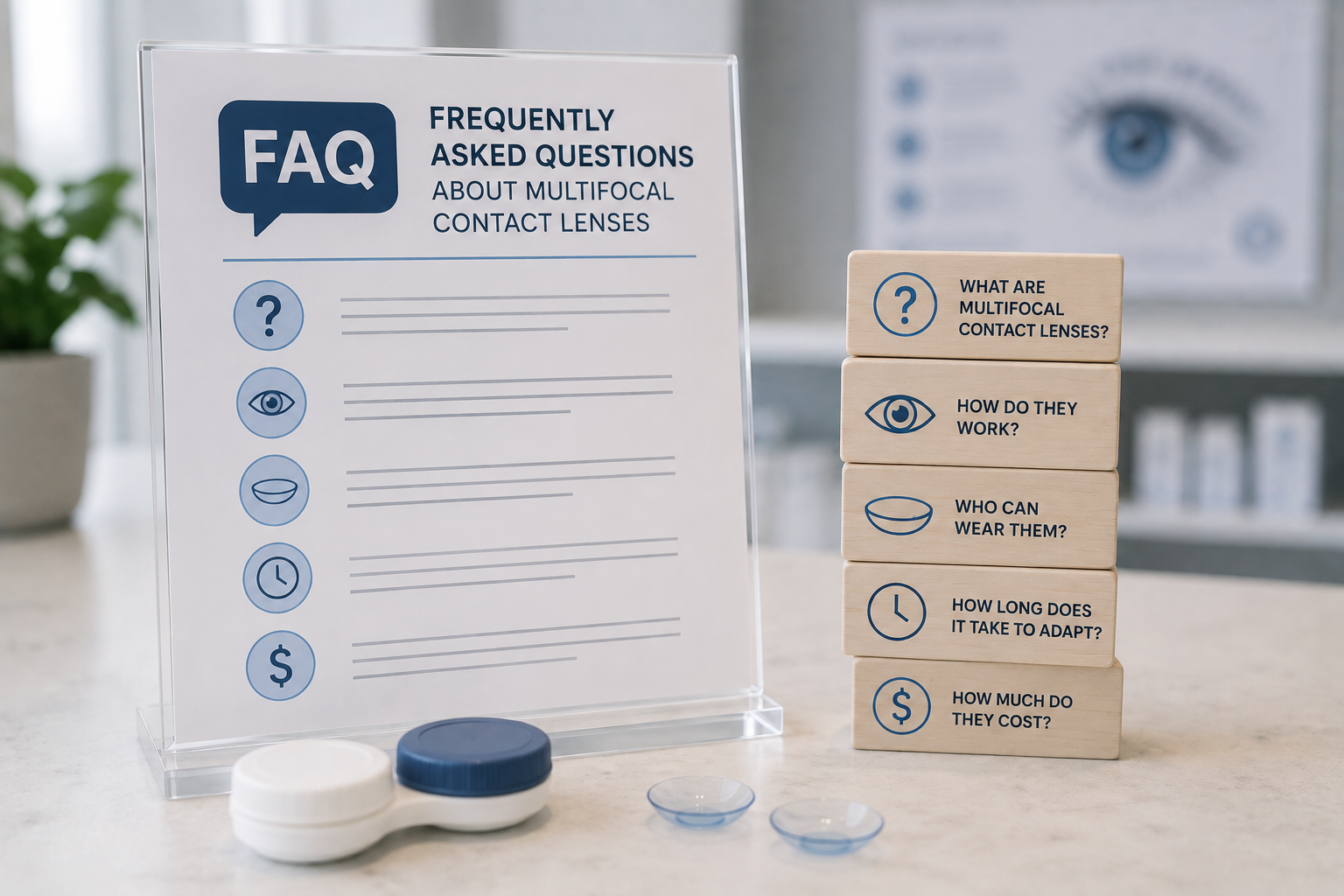
Frequently Asked Questions About Multifocal Contact Lenses
-
Most patients at Texas Contact Lens Institute complete the multifocal fitting process within two to four appointments spread over three to six weeks. The initial diagnostic and trial fitting session takes 60 to 90 minutes. Follow-up visits, typically one to two, are shorter and focus on verifying vision stability and lens performance before the final lens order is placed.
-
Yes, but the fitting process is more involved. Standard soft multifocals often fail in eyes with significant dry eye or post-surgical corneal changes because the generic lens design cannot accommodate an altered ocular surface. Custom multifocal lens options, including specialty soft and scleral multifocal designs, are specifically suited to these cases and are a core part of what Texas Contact Lens Institute fits.
-
The fitting process includes built-in follow-up visits designed to catch and correct exactly this situation before the final lens is ordered. If a lens design is not performing correctly at a follow-up, the parameters are adjusted and a new trial is conducted. Dr. Summers documents corneal topography and refraction at the first appointment, giving every follow-up a measurable baseline to compare against rather than relying on subjective feedback alone.
-
Cost depends on the type of lens required, the number of fitting appointments needed to reach a stable result, and the complexity of your corneal and visual prescription. Custom lenses for patients with astigmatism, dry eye, or post-surgical corneas cost more than standard soft multifocals because they require custom manufacturing and additional fitting time. Call or text (972) 299-8675 for a cost estimate based on your specific situation.
-
The practice operates by appointment only, Monday through Friday, 9:00 AM to 3:00 PM, at 6020 W Parker Rd Ste 260, Plano, TX 75093. Specialty lens consultations are free of charge. Call or text (972) 299-8675, or email info@texascontactlens.com to schedule. If you were referred by another eye doctor, your provider can submit a referral directly by phone, email, or online form.
Book Your Multifocal Contact Lens Fitting in Plano Today
If you have been struggling with reading glasses, failed multifocal trials, or blurry intermediate vision, a precision-fitted custom multifocal lens may be the solution you have not yet had access to. Texas Contact Lens Institute offers free specialty consultations at our Plano clinic, where every fitting is performed personally by Dr. Beth Summers, FAAO, FSLS. Call or text (972) 299-8675, or email info@texascontactlens.com to schedule your appointment. Monday through Friday availability, by appointment only.