Dry Eye
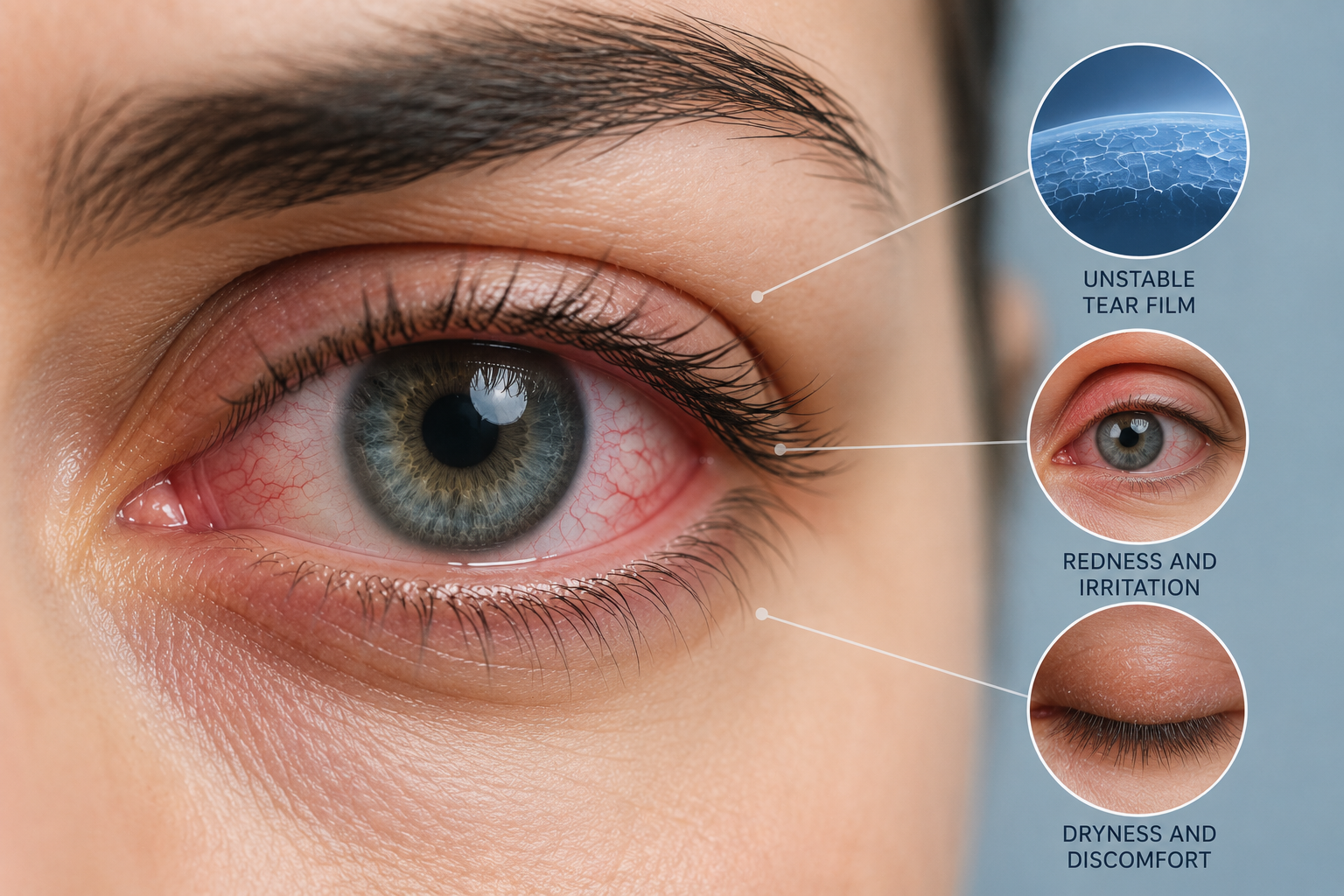
For millions of individuals, dry eye syndrome (also known as dry eye disease) can be far more than a minor inconvenience; it may be a daily struggle. It often manifests as a constant, gritty sensation, as if there is sand in your eyes, accompanied by burning, redness, blurry vision, and a frustrating paradox of excessive watering. Simple, everyday activities like staring at a computer screen, driving at night, reading a book, or even sitting in an air-conditioned room can become uncomfortable. When chronic dry eye sets in, it can chip away at your quality of life and make you feel like your eyes are constantly tired or irritated.
One reason dry eye feels so annoying is that standard over-the-counter artificial tears do not fix the root problem; they merely offer a fleeting bandage for a complex issue. True, long-lasting relief requires targeting the underlying breakdown of your ocular surface and tear film chemistry. Fortunately, advanced clinical eye care has evolved far beyond standard eye drops, offering highly customized, medical-grade therapies designed to restore a healthy tear environment and protect your vision.
To conquer this frustration, our specialized practice utilizes a tiered, comprehensive treatment approach tailored to your specific ocular profile. Prescription medication eye drops can help treat underlying inflammation and the root cause of dryness. They can stimulate healthy natural tear production. Additionally, we can utilize in-office procedures to alleviate dry eye such as punctal plugs. Punctal plugs are tiny, biocompatible inserts placed seamlessly into the tear ducts, to naturally retain your eye's own moisture. For patients suffering from severe ocular surface disease, custom scleral lenses may act as a revolutionary solution; these large-diameter, gas-permeable lenses arch completely over the sensitive cornea, holding a continuous, soothing reservoir of preservative-free saline directly against the eye all day long to heal the surface and block out irritation.
Our practice emphasizes a comprehensive approach to dry eye disease, integrating advanced therapies with essential lifestyle and environmental adjustments.
Keratoconus
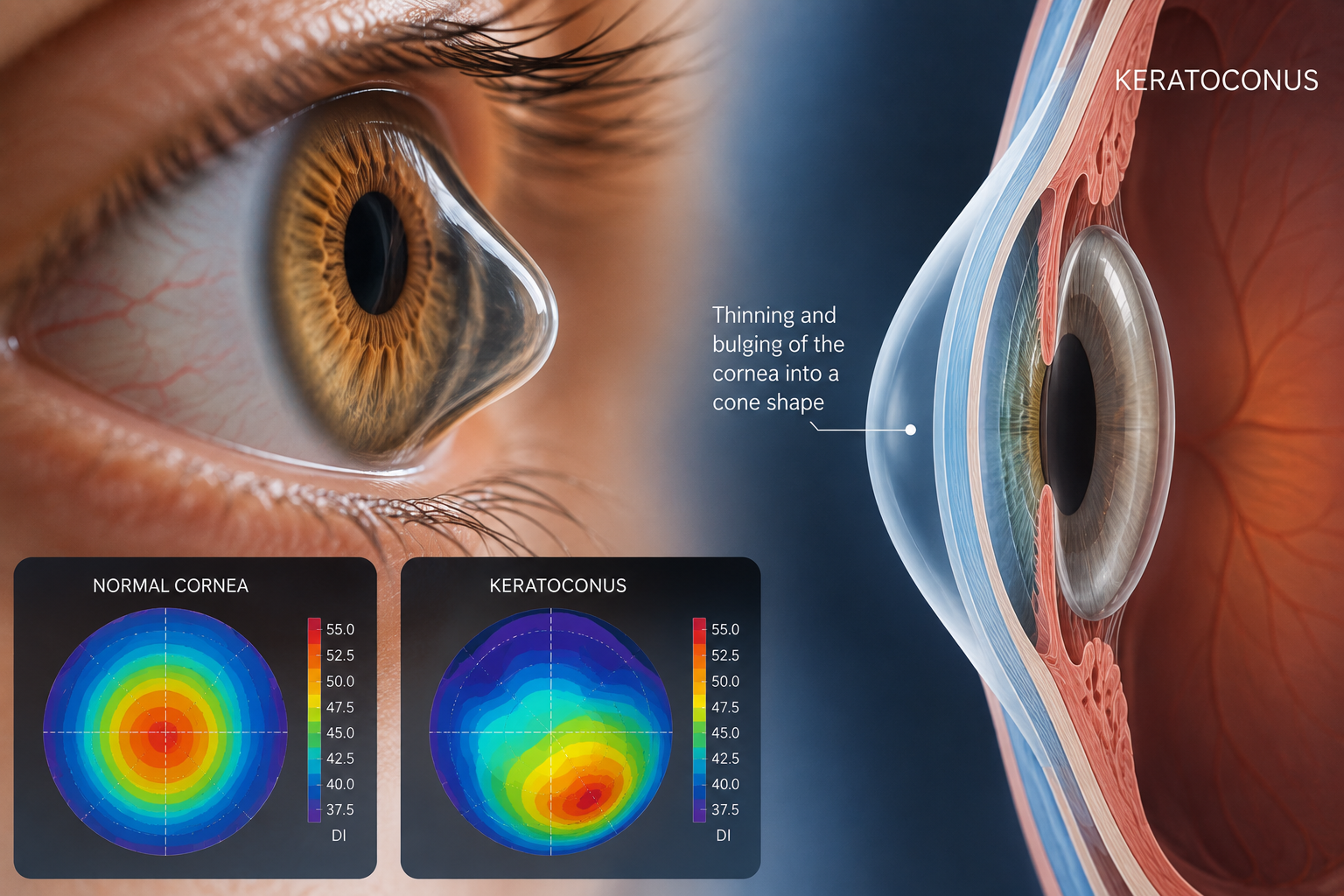
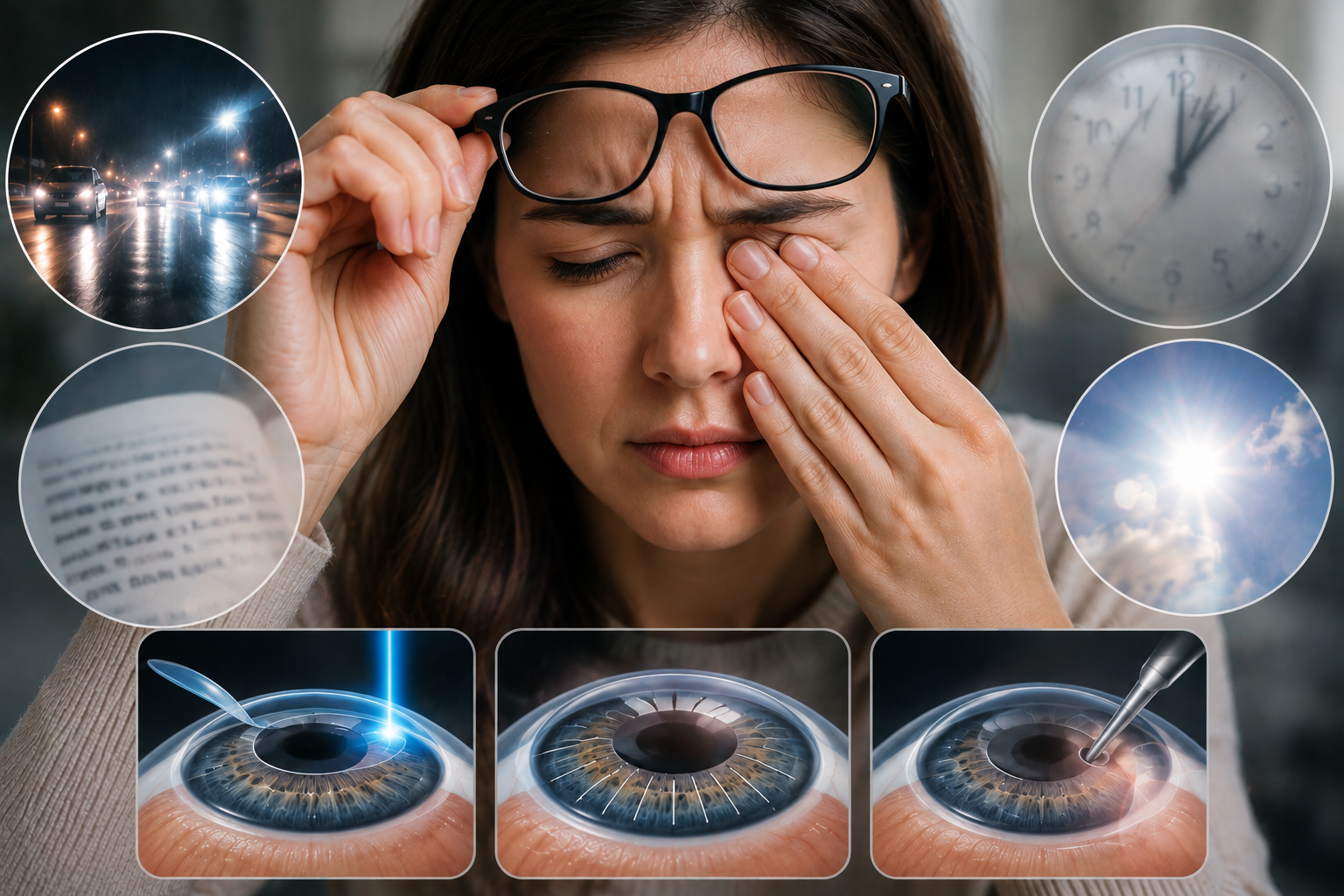
In its early stages, keratoconus is often mistaken for standard astigmatism, but as the condition progresses, the cornea, the clear, round window of your eye, gradually thins and begins to bulge outward into an irregular, cone-like shape. This structural changes scatters light as it enters the eye, triggering a frustrating barrage of visual disruptions. Patients frequently experience severe ghosting, double vision, overlapping images, and a relentless sensitivity to glare and night driving that standard eyeglasses or traditional soft contact lenses simply cannot fix.
Tasks that most people take for granted, such as reading fine print, working efficiently on a computer, recognizing faces from a distance, or driving become daily hurdles. Because the corneal distortion is irregular, patients often find themselves trapped in a discouraging cycle of frequent prescription changes, searching for a clarity that standard vision corrections promise but fail to deliver.
True visual rehabilitation for keratoconus requires a specialized approach that completely bypasses the irregular corneal surface. Our advanced clinical practice specializes in utilizing custom scleral lenses to restore pristine visual acuity. These large-diameter, gas-permeable lenses rest gently on the sclera (the white of the eye) and completely vault over the irregular, cone-shaped cornea. By creating a perfectly smooth, fluid-filled dome over the eye, scleral lenses mask the underlying distortion, precisely bending light to deliver crisp, stable, and life-changing vision to patients who thought they had exhausted all options. We are also highly experienced in rigid gas permeable lenses (RGPs), hybrid lenses, and keratoconus-specific soft lenses.
Beyond optical correction, we comprehensively manage your condition by co-managing your care with elite cornea specialists to monitor structural progression. Keratoconus is a progressive condition. When a patient exhibits signs of active corneal thinning or steepening, we immediately facilitate a referral for corneal cross-linking (CXL)—a critical medical procedure designed to strengthen the corneal tissue and halt the progression of the disease. By combining cutting-edge lens engineering with timely surgical intervention, we ensure your long-term ocular health and visual clarity are fully protected.
Myopia Management
For many parents, watching their child’s vision deteriorate year after year is a deeply concerning experience. Progressive myopia, or worsening nearsightedness, is far more than just needing a stronger pair of glasses every time school starts; it is a rapid physical changes where the eye grows too long. This continuous elongation not only blurs distant vision but also stretches the retina, the delicate internal tissues of the eye. It can feel like an unsettling, unstoppable cycle as a child's dependence on heavy lenses increases, leaving parents wondering where the progression will finally stop and how it will impact their child's future.
What makes progressive myopia so critical to address early is that it is not just a cosmetic or lifestyle inconvenience. Leaving worsening nearsightedness unchecked significantly elevates a child's long-term risk for serious, sight-threatening ocular complications later in life, including retinal detachments, glaucoma, early cataracts and myopic maculopathy. Relying solely on standard eyeglasses does absolutely nothing to slow down this structural elongation, it merely acts as a temporary patch to help them see through the blur, while the underlying issue continues to quietly advance.
Fortunately, modern clinical eye care offers highly proactive, evidence-based solutions designed to actively slow down myopia progression. Our dedicated myopia management protocols focus on slowing down the rapid elongation of the eye during a child's critical growth years. Through customized treatment pathways, including advanced orthokeratology (Ortho-K) specialist lenses worn comfortably overnight to gently reshape the cornea, specialized daytime multifocal contact lenses, targeted prescription medical therapies, and new myopia management glasses lenses, we can significantly decelerate the progression of nearsightedness. This specialized care doesn't just keep their prescription manageable today; it actively safeguards their eye health and preserves their vision for the future.
Post-Surgical Complications
Undergoing a major eye surgery like a corneal transplant, refractive surgery (such as LASIK, PRK or RK), or a complex cataract procedure comes with the exciting promise of restored, crystal-clear vision. However, when the healing process doesn't go exactly as planned, or when structural complications arise, the disappointment can be devastating. Patients often find themselves dealing with an unexpected, highly irregular corneal surface caused by post-operative scarring, asymmetric healing, or ectasia. Instead of flawless vision, they are left facing a severe, distorted blur, severe light sensitivity, and fluctuating visual clarity that leaves them feeling deeply discouraged.
The daily reality of post-surgical visual distortion is uniquely frustrating because standard optical solutions are completely ineffective against an irregular, surgically altered cornea. Standard eyeglasses cannot compensate for the uneven microscopic dips and peaks on the eye's surface, and traditional soft contact lenses simply conform to the irregular shape rather than correcting it. This leaves patients caught in a disheartening limbo, having gone through a major surgical procedure, yet still struggling to read, drive safely, or enjoy a comfortable, glare-free visual environment.
Reaching a successful visual endpoint after surgical complications requires an elite tier of specialized lens engineering. Our practice excels in rehabilitating vision for surgically compromised corneas by designing highly sophisticated, customized scleral lens systems. Because these lenses arch completely over the sensitive, altered corneal tissue without touching it, they eliminate mechanical friction on delicate surgical zones or transplant grafts. The continuous reservoir of preservative-free saline beneath the lens intensely hydrates the ocular surface, while the pristine optical surface of the lens flawlessly corrects the irregular astigmatism, finally delivering the stable, sharp, and comfortable vision you expected from the start.
Sjögren’s Syndrome
Sjögren’s Syndrome is a systemic autoimmune condition that aggressively targets the body’s moisture-producing glands, with the tear-producing lacrimal glands and salivary glands frequently bearing the brunt of the attack. When the lacrimal glands are compromised, the eye is starved of the essential aqueous layer needed to form a healthy tear film. For Sjögren’s patients, this results in an unrelenting, severe form of dry eye disease that goes beyond simple dryness.
The chronic nature of Sjögren's-related dry eye is uniquely annoying because standard over-the-counter drop therapies offer virtually no lasting relief. Because the underlying inflammation continuously degrades the delicate ocular surface, artificial tears evaporate almost instantly, leaving the sensitive cornea completely exposed to friction from the eyelids with every single blink. This constant mechanical friction can lead to pain, chronic inflammation, and fluctuating, blurred vision that limits your productivity and dampens your daily quality of life.
Managing the severe ocular manifestations of Sjögren’s Syndrome requires a highly proactive, multi-tiered clinical approach to protect and restore the ocular surface. Our specialized practice utilizes custom scleral lenses as a primary line of defense; these advanced lenses vault entirely over the compromised cornea, locking in a continuous, soothing reservoir of preservative-free saline that acts as an artificial tear film that never evaporates. To comprehensively manage the systemic dryness, we seamlessly combine this lens therapy with targeted prescription medicine protocols to calm deep-seated inflammation, punctal plugs to maximize any natural moisture, and advanced biologically active therapies to help heal the eye.
Stevens-Johnson Syndrome
Stevens-Johnson Syndrome (SJS) is a rare, severe immune-mediated reaction that can cause catastrophic, life-altering complications on the ocular surface. During the acute phase of this condition, intense inflammation often damages the delicate mucous membranes of the eyelids and conjunctiva, leading to severe scarring, compromised tear glands, and inward-turning eyelashes. For survivors, the chronic aftermath is painful and exhausting; patients are frequently left battling a relentless form of dry eye, severe light sensitivity, and a constant, agonizing friction every single time they blink.
The daily visual and physical disruption of post-SJS ocular surface disease cannot be managed with standard optical solutions. Traditional artificial tears drain away within minutes, and standard soft contact lenses can irritate the fragile, scarred tissue. This leaves patients feeling deeply discouraged as they struggle with chronic ocular pain, a persistent gritty sensation, and severely blurred or fluctuating vision that heavily impacts their independence and quality of life.
Our specialized practice utilizes advanced custom scleral lens systems to aggressively rehabilitate and protect eyes compromised by Stevens-Johnson Syndrome. By vaulting completely over the fragile cornea without touching it, these large-diameter lenses rest gently on the less-sensitive white part of the eye, completely eliminating painful eyelid friction. The lens traps a continuous, soothing reservoir of preservative-free sterile saline directly against the ocular surface, hydrating the eye all day long, calming deep-seated inflammation, and masking corneal irregularities to restore crisp, stable, and comfortable vision.
Corneal Scarring
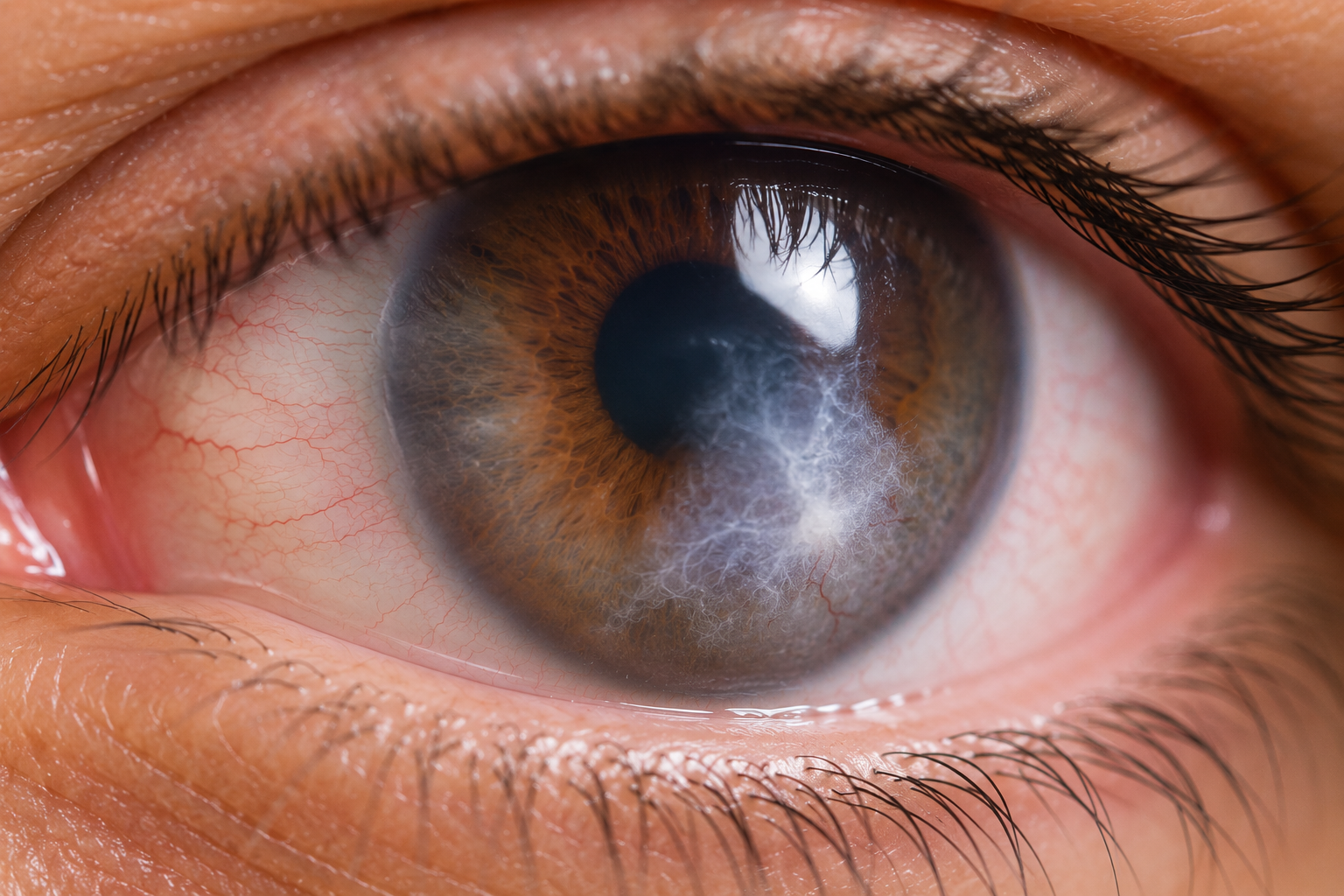
Whether resulting from a past physical injury, chemical burn, severe contact lens infection, advanced corneal ulcers or prior eye surgery a corneal scar can permanently disrupt how you experience the world. The cornea must remain clear and smooth to accurately bend and focus incoming light onto the retina. When scarring alters this delicate structure, it creates microscopic dips, peaks, and opaque zones across the eye's surface, scattering light irregularly and triggering an array of visual distortions.
Living with corneal scarring is uniquely annoying because standard eyeglasses and traditional soft contact lenses are ineffective against structural surface irregularities of the eye. Standard contact lenses simply conform to the uneven shape of the scar rather than correcting it, leaving patients dealing with persistent ghosting, severe halos around light sources, double images, fluctuating vision and a highly disruptive sensitivity to glare. This can make crucial daily tasks, such as night driving, reading fine print, or working comfortably on digital screens, feel difficult.
To overcome these structural irregularities, we design highly precise, customized scleral lenses that bypass the scarred corneal tissue entirely. Because these gas-permeable lenses arch completely over the cornea, the fluid-filled chamber beneath the lens naturally fills in all the microscopic imperfections caused by the scar tissue. This effectively replaces your irregular, scarred cornea with a perfectly smooth, uniform optical surface, allowing light to focus cleanly and predictably to deliver the sharp, stable, and clear vision you thought was permanently lost.
Post-Corneal Transplant
Undergoing a corneal transplant is a major surgical milestone aimed at replacing diseased or damaged tissue to restore your sight. However, once the surgical grafts have fully healed and the sutures are removed, many patients are surprised to find that their vision is still severely distorted. Because the donor tissue rarely matches the recipient’s eye geometry perfectly, post-surgical corneas often develop high amounts of irregular astigmatism, structural asymmetry, or extreme surface variations that cause blurry vision. Often standard eyeglasses or traditional soft contact lenses still cannot provide acceptable visual clarity.
Though RGPs often also provide good vision, fit and comfort, they cannot match the comfort and post-surgical visual rehabilitation that expertly designed custom scleral lens systems can offer to the right candidate. These advanced lenses are engineered to clear the delicate transplant graft entirely, resting their weight solely on the stable sclera to avoid applying mechanical pressure or friction to the sensitive surgical junction. The continuous reservoir of preservative-free saline beneath the lens heavily hydrates the eye to support long-term graft health, while the pristine optics of the lens flawlessly masks the post-operative astigmatism, finally unlocking sharp, clear, and stable vision.