
Specialty Contact Lens Services in Plano, TX
Texas Contact Lens Institute is a referral-tier specialty clinic. Every service listed here exists for one reason: to correct vision that standard glasses and off-the-shelf contact lenses cannot. Patients arrive with keratoconus, irregular corneas, surgically altered eyes, corneal scarring, or ocular surface disease severe enough that routine care has run out of options.
Every fitting is performed personally by Dr. Beth Summers, OD, MS, FAAO, FSLS, a fellowship-credentialed specialty lens optometrist. This practice does not perform routine eye exams and does not sell eyeglasses. Patients return to their primary eye care provider for general care while we manage the specialty lens side of their vision.
Specialty lens consultations are free of charge.
Specialty Lenses for Irregular and Compromised Corneas
When the corneal surface is steep, asymmetrical, scarred, or surgically altered, a lens has to bypass that irregularity rather than conform to it. These three designs do exactly that, and the right one depends on the shape and severity of your specific cornea.
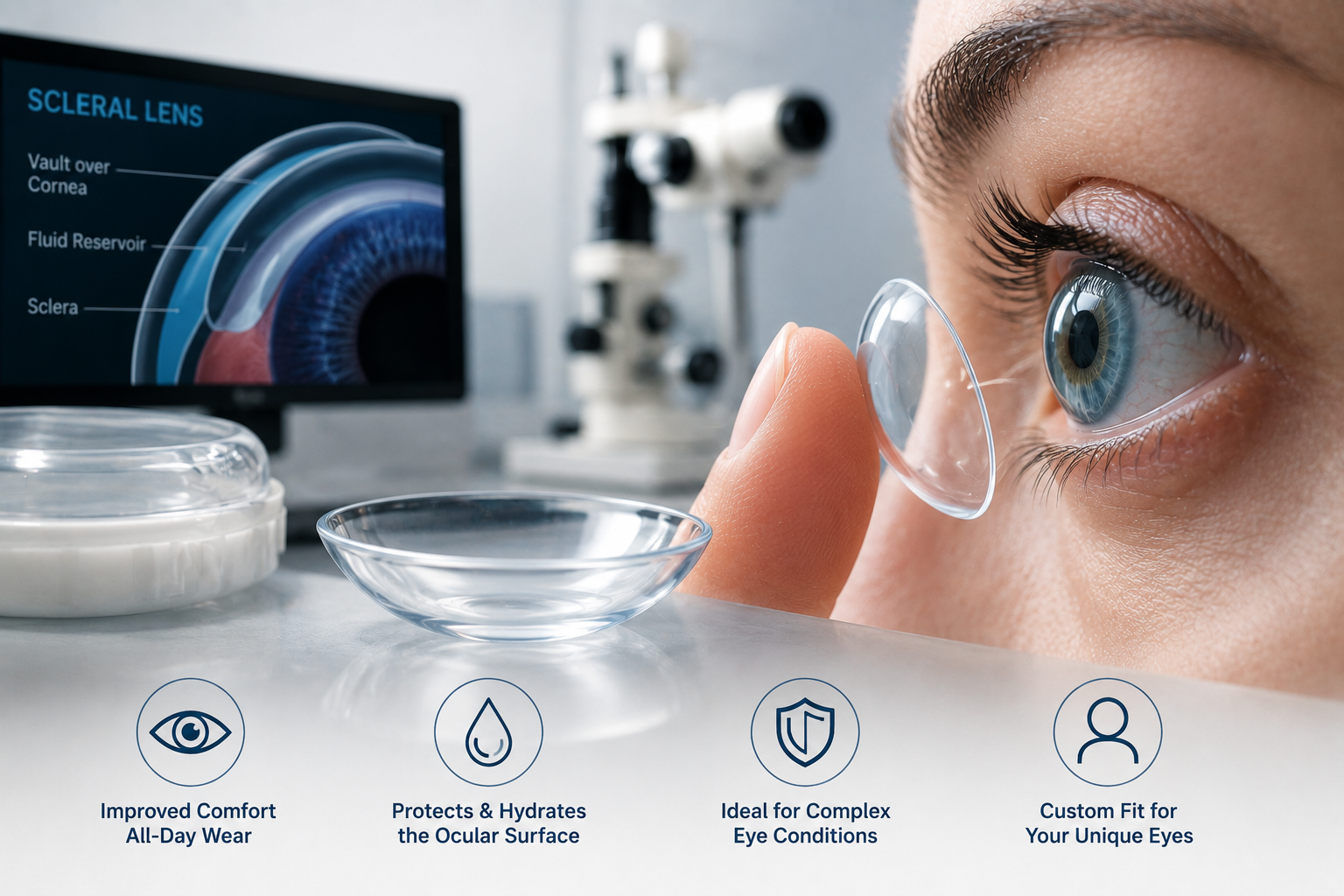
Large-diameter, gas-permeable lenses that vault completely over the cornea and rest on the white of the eye, holding a continuous reservoir of preservative-free saline against the ocular surface. They correct vision and protect the eye simultaneously, which makes them the primary design for keratoconus, corneal scarring, post-surgical eyes, and severe dry eye.
Custom Scleral Lenses

A rigid gas-permeable center surrounded by a soft outer skirt. The rigid optic corrects the irregularity while the soft skirt keeps the lens centered and comfortable, making hybrids a strong option for patients who need RGP optics but have not tolerated a full rigid lens.
Hybrid Contact Lenses

Rigid lenses that hold a precise optical shape against the cornea rather than draping over its distortion. The tear layer that forms beneath the lens neutralizes surface irregularity, delivering sharp, stable vision for advanced astigmatism, mild to moderate keratoconus, and post-transplant eyes.
Rigid Gas Permeable (RGP) Contact Lenses
Lenses That Restore Appearance and Reduce Light Sensitivity
Custom Prosthetic and Cosmetic Lenses
Individually fabricated lenses that replicate the color, iris pattern, limbal ring, and pupil size of your fellow eye. They are designed for eyes affected by trauma, congenital defects, surgical complications, or corneal scarring, and the built-in tint reduces the glare and photophobia that often accompany a compromised iris. These are one-of-a-kind medical devices, not stock colored lenses.

Vision Correction and Myopia Control
Orthokeratology (Ortho-K)
Custom rigid lenses worn only during sleep that gently reshape the cornea overnight, giving clear vision through the day with nothing worn. Ortho-K is most often prescribed for children whose prescriptions are progressing year over year, because it slows the axial elongation that drives long-term risk. Adults use it for daytime freedom from correction.
Custom Soft and Multifocal Contact Lenses
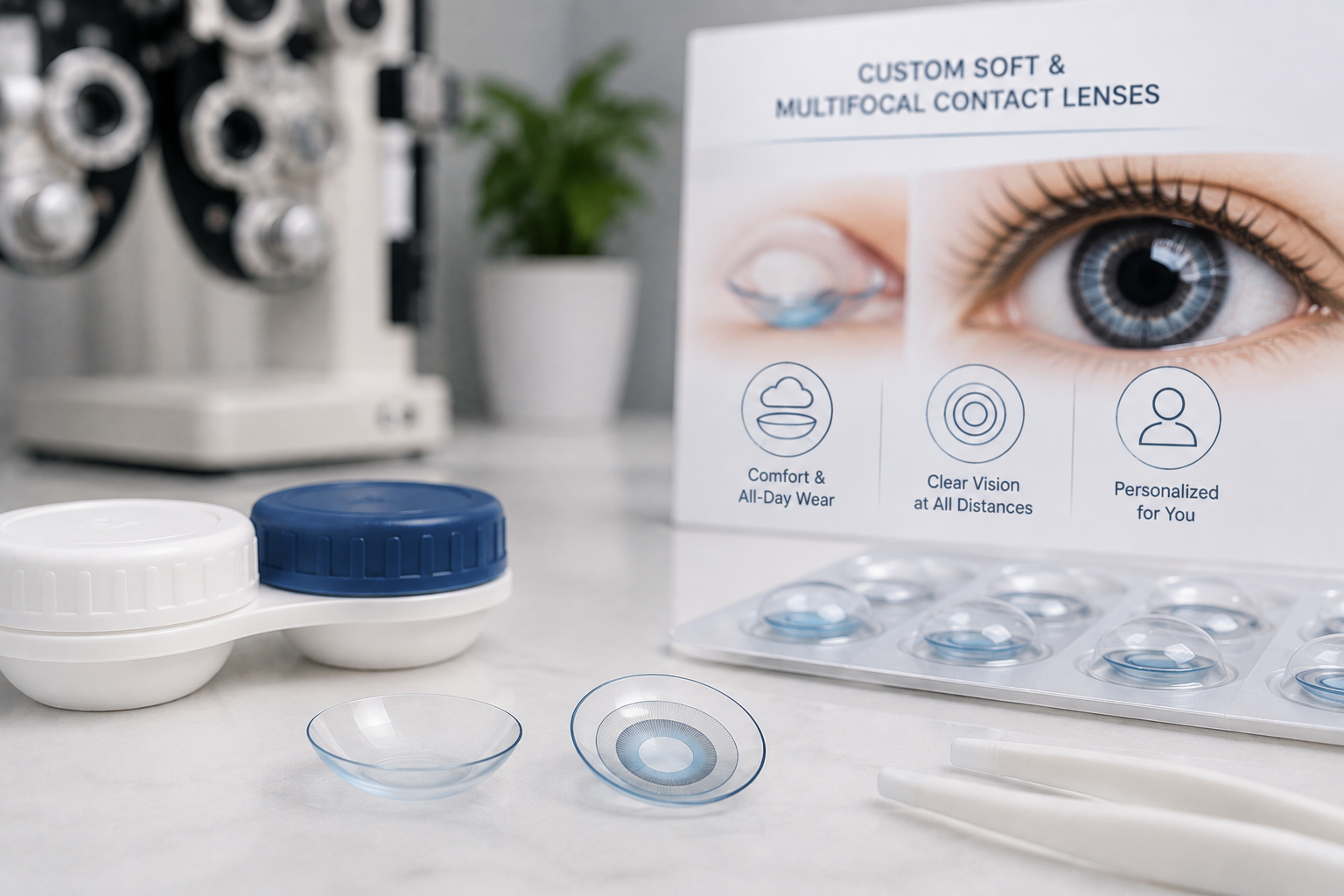
Multifocal lenses correct near, intermediate, and distance vision in a single lens. Standard multifocals assume a predictable corneal shape and pupil response, which is why they frequently fail for patients with dry eye, astigmatism, or a history of refractive surgery. Custom designs are built around your actual corneal geometry instead.

Ocular Surface and Dry Eye Treatment
Dry Eye Treatment
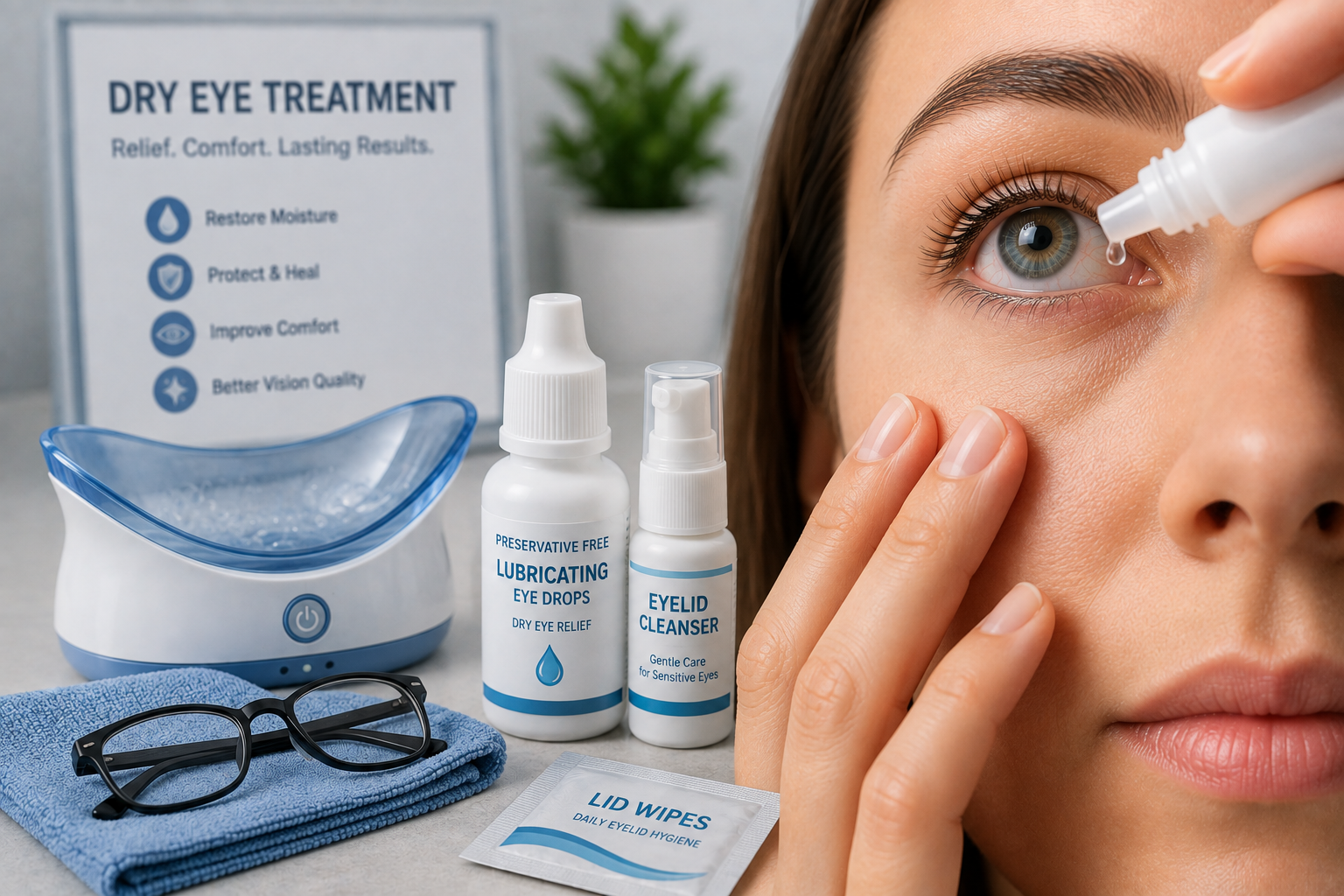
Chronic dry eye is not one condition, and it does not respond to one protocol. Treatment begins with imaging that identifies the subtype and severity, then applies the appropriate tier of intervention. Available therapies include prescription anti-inflammatory medications, punctal plugs, autologous serum eye drops, amniotic membrane therapy, nutritional and lid hygiene protocols, and scleral lenses for severe or refractory cases.
How Every Fitting Works
The process is the same regardless of which lens you need.
Advanced diagnostic imaging. Corneal topography and ocular surface analysis map the three-dimensional shape of your eye in detail a standard refraction cannot capture.
Custom lens engineering. Using that dataset and, in most cases, a trial lens fitting, the lens is designed to the micron-level measurements of your eye.
Co-managed care and follow-up. Periodic visits monitor corneal health and fit stability. Routine exams stay with your primary eye care provider.

Why Patients Are Referred Here

Specialty lens outcomes depend almost entirely on the diagnostics, the design process, and the clinical judgment of the fitting optometrist. Dr. Summers holds fellowships from both the American Academy of Optometry (FAAO) and the Scleral Lens Education Society (FSLS), authored "Fitting the Surgically Compromised Cornea" for Review of Cornea and Contact Lens, and holds a faculty appointment at SUNY College of Optometry.
Because this practice maintains no optical dispensary and performs no routine exams, referring optometrists and ophthalmologists send patients here without competing for their own care.
Read about Dr. Beth Summers · Information for referring providers

Common Questions
-
You do not need to decide before your consultation. The lens platform is selected from your corneal topography, the condition being treated, and how your eye responds to trial lenses during the fitting. Patients frequently arrive expecting one design and leave fitted with another that performs better on their specific cornea.
-
No. Many patients arrive on referral from an optometrist, ophthalmologist, or cornea surgeon, but a formal referral is not required to book. If you have prior corneal topography, surgical records, or contact lens fitting notes, bring them — they reduce diagnostic duplication at the first visit.
-
No. This is an out-of-network practice and it does not bill insurance directly. A complete medical superbill is provided on request after your fitting is complete, which you submit independently to your insurer. Many plans with out-of-network benefits reimburse a portion of medically necessary specialty lenses, particularly for diagnoses like keratoconus or corneal transplant.