
At What Age Should Myopia Management Start? What Parents Need to Know
Myopia management should ideally start as soon as a child receives a myopia diagnosis, with evidence supporting intervention from as early as age 6. The younger a child is when myopia begins, the longer they have for the condition to progress, making early treatment significantly more impactful on their lifetime vision health.
Key Takeaways
Children diagnosed with myopia at age 6 or 7 face a far longer progression window than those diagnosed at 10 or 11, making earlier intervention more critical.
"Pre-myopia" is now a recognized clinical category, and children showing early signs can benefit from monitoring before full myopia develops.
Delaying myopia onset by even one year may provide greater lifetime benefit than multiple years of active progression control.
Treatment options include atropine drops (suitable from age 4), orthokeratology lenses (from age 6), and soft contact lenses (from ages 7 to 8).
Myopia management does not typically stop at first contact; most eye care providers continue treatment through the late teens or early adulthood, when progression slows significantly.
Risk factors including genetics, limited outdoor time, and screen habits should be assessed at every annual eye exam.
How Myopia Progresses in Children and Why Timing Matters
Myopia develops when the eye grows too long, causing distant objects to appear blurry. In children, this growth is active and ongoing, which is why the condition rarely stays stable during school-age years. Progression is fastest between ages 7 and 10 and generally slows through the mid-teens before stabilizing in most people by their late teens or early twenties.
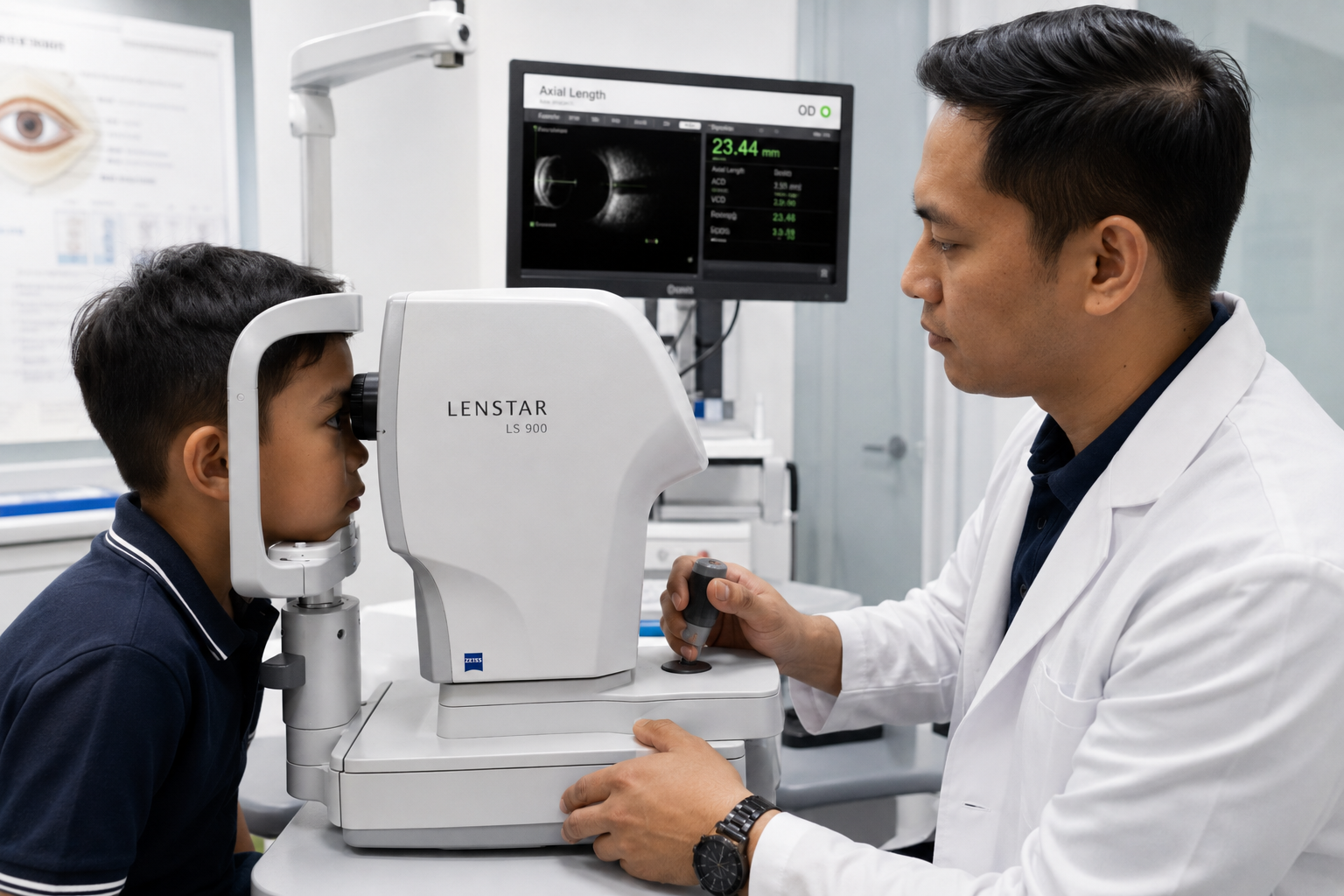
According to the IMI 2025 Digest published by the Myopia Institute, updates to clinical management guidelines now emphasize the concept of "pre-myopia," defined as a spherical equivalent between -0.50D and +0.75D. This zone is considered a critical intervention window, with treatment recommended when annual myopia progression reaches or exceeds 0.75D or axial length growth reaches 0.20mm per year. In other words, you do not have to wait for a child to become significantly myopic before taking action.
A child myopic at age 6 or 7 has a substantially longer runway of eye growth ahead of them compared to a child diagnosed at age 10 or 11. This makes early detection and early treatment some of the most powerful tools available.
When Should Myopia Management Actually Begin?
The short answer: as soon as myopia is confirmed, and possibly before. The 2025 Myopia Management White Paper, as highlighted by Review of Myopia Management, establishes that pre-myopia is now a legitimate clinical category warranting active monitoring. Over 2,500 peer-reviewed papers on childhood myopia were published globally in 2024 alone, reflecting the urgency the scientific community places on early action.
Key risk factors that should prompt earlier monitoring include:
Family history: A child with two myopic parents faces significantly higher risk.
Insufficient hyperopic reserve: Children with less than +0.75D of farsightedness at ages 6 to 7 are at elevated risk of developing myopia. Cycloplegic spherical equivalent error is now considered the single best predictor of onset, according to VisionCenter's 2025 myopia statistics resource.
High screen time and limited outdoor activity: These environmental factors accelerate onset.
Ethnic background: Children of East Asian descent face higher prevalence rates, though the condition is rising across all demographics.
If your child has two or more of these risk factors, annual eye exams with axial length measurement should begin by age 5 or 6, even before myopia appears.
The Real Benefit of Starting Myopia Control Early
Delaying myopia onset by even one year may provide greater lifetime benefit than several years of active progression control. This is one of the most important concepts in modern pediatric eye care.
Because treatment efficacy is measured as a percentage reduction in progression rate, the same treatment applied to a younger child with faster natural progression will produce a larger absolute benefit. A 50% reduction in progression at age 7 prevents far more total dioptric change than the same 50% reduction at age 12, simply because progression is faster in younger children.
Randomized clinical trials have demonstrated that children receiving 0.05% atropine drops were half as likely to become myopic compared to placebo over two years. Statistics report. Those same trials also showed that increased outdoor time reduced incident myopia by up to 9% in absolute terms.
The global scale of this issue adds urgency. A 2024 analysis projects that over 740 million children and teenagers could be affected by myopia by 2050, per data reported by CarrotByte's 2025 myopia statistics for Asia. The global myopia management market reflects this trajectory, valued at $3.2 billion in 2024 and forecast to reach $10.4 billion by 2033, growing at a compound annual rate of 14.1%.

Which Treatment Option Is Best for a Young Child?
There is no universal answer, but age does shape which treatments are practical and safe.

Atropine drops offer the lowest barrier to entry for very young children. Orthokeratology is a strong option from age 6 onward for children and parents comfortable with lens handling. The right choice depends on your child's maturity, your household routine, and the clinical judgment of your eye care provider.
Side effects and monitoring matter here. Atropine at low doses has a favorable safety profile, though some children experience mild light sensitivity. Ortho-K lenses carry a small infection risk if hygiene protocols are not followed carefully. No treatment should be started without a full baseline assessment including cycloplegic refraction and axial length measurement.
When Should Myopia Management Stop?
Treatment is generally continued until progression stabilizes, which happens for most people by the late teens. Research suggests that 75% of individuals have stable myopia by age 18, with the majority reaching full stabilization by their mid-twenties.
One important consideration is the rebound effect. If treatment, particularly atropine, is stopped abruptly rather than tapered, some children experience a temporary acceleration in progression. Your eye care provider should guide a gradual reduction in treatment intensity once stabilization is confirmed, rather than stopping cold.
Monitoring should continue even after treatment ends, since a small percentage of adults do experience late progression, particularly in professions requiring intense near work.

Things to Know
Annual axial length measurement is now considered a best-practice standard, not an optional add-on, for any child in a myopia management program.
Pre-myopia is a real clinical category. Do not wait for a confirmed myopia diagnosis before discussing monitoring with your provider.
The NIH's resources on childhood refractive errors can provide additional context on how refractive conditions develop.
Compliance is the biggest variable in real-world outcomes. A treatment that a child will actually use consistently outperforms a theoretically superior treatment with poor adherence.
Genetics and outdoor time are the two most modifiable risk factors you can act on before any prescription treatment begins.
Frequently Asked Questions
Q: Can a 5-year-old start myopia management?
Yes, atropine drops can be used in children as young as age 4 in appropriate clinical settings.
Most structured myopia management programs begin at age 6 or 7 when school-age visual demands increase, but a child showing rapid progression earlier can be treated sooner under careful supervision.
Q: How do I know if my child is at risk for myopia before it develops?
A cycloplegic refraction measuring hyperopic reserve is currently the single best predictor of myopia onset.
Children with less than +0.75D of hyperopic reserve at ages 6 to 7 should be monitored closely. Family history of myopia, high screen time, and limited outdoor time are additional warning signs.
Q: Does myopia management actually work or just slow things down slightly?
Myopia management meaningfully reduces the rate of progression, not just by a small margin.
Randomized trials show that 0.05% atropine made children half as likely to become myopic over two years compared to placebo. Slowing progression also reduces the long-term risk of serious complications like retinal detachment and glaucoma associated with high myopia.
Q: What questions should I ask at my child's next eye exam?
Ask about axial length measurement, hyperopic reserve, and whether your child's current prescription trend warrants starting a formal myopia management plan.
Bring up any family history of myopia and document how many hours per day your child spends on screens versus outdoors. This information shapes the risk assessment.
Q: Where in the Dallas area can my child get a myopia management evaluation?
Texas Contact Lens Institute in Plano, TX offers myopia management consultations for children.
Located at 6020 W Parker Rd, Suite 260, Plano, TX 75093, they can be reached at +1 972-299-8675. Early evaluation gives your child the best chance at meaningful intervention before significant progression occurs.
The Bottom Line on At What Age Should Myopia Management Start
The evidence is clear: earlier is better. Waiting until myopia is severe before addressing it means missing the most impactful window for slowing eye growth. The ideal starting point is as soon as risk factors appear or a diagnosis is confirmed, often between ages 5 and 8, with annual monitoring continuing through adolescence.
If your child has a family history of myopia, spends significant time on screens, or has already received a mild prescription, schedule a comprehensive pediatric eye exam that includes axial length measurement. For families in the Plano and Dallas area, Texas Contact Lens Institute at 6020 W Parker Rd, Suite 260 is a strong starting point. Call +1 972-299-8675 to schedule an evaluation and get ahead of progression before it becomes difficult to manage.
