
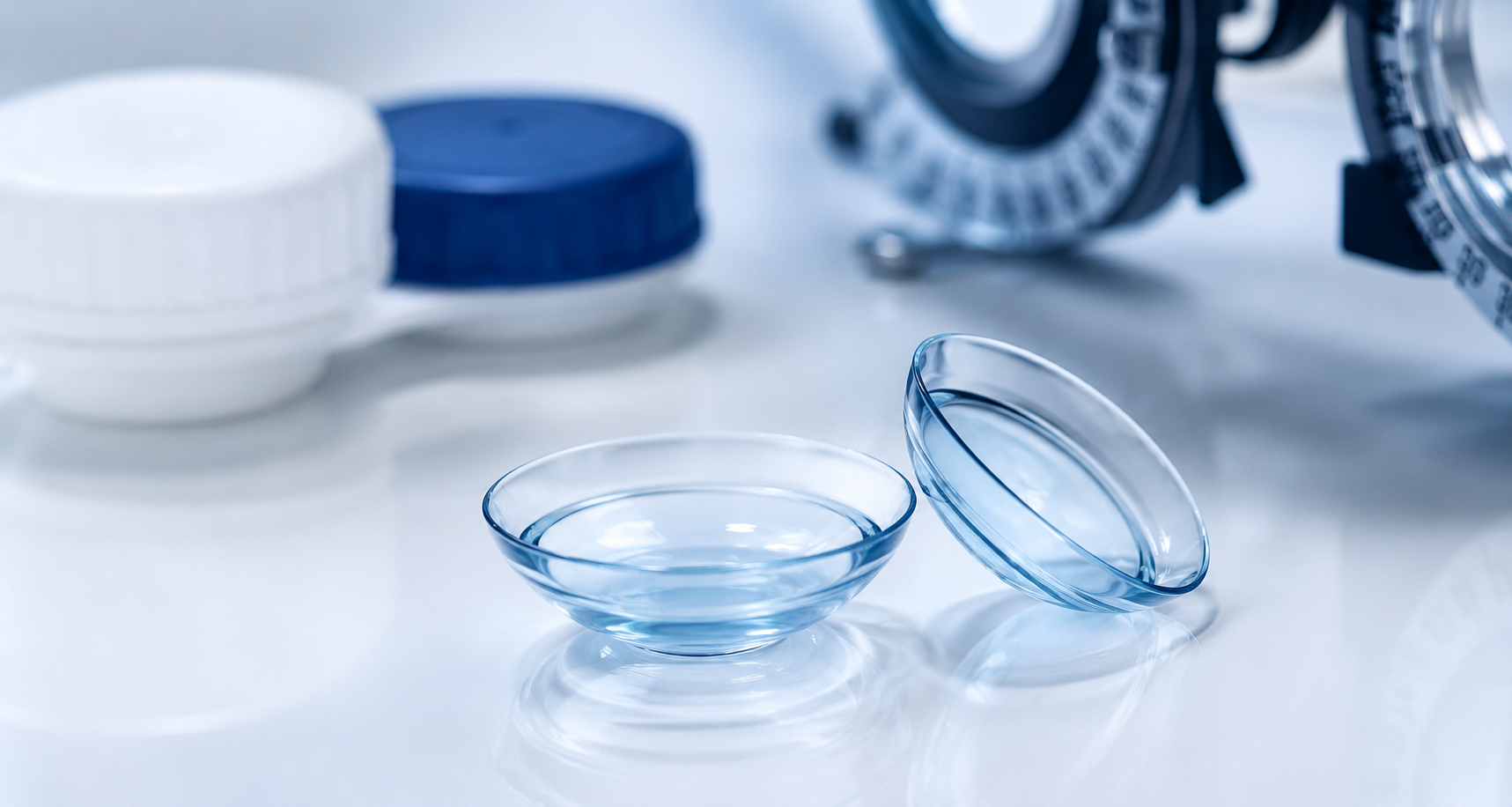
Hybrid Contact Lenses in Plano, TX
Hybrid contact lenses pair a rigid gas permeable center with a soft outer skirt for RGP-level clarity and soft-lens comfort fitted personally by Dr. Beth Summers in Plano for keratoconus, advanced astigmatism, and irregular corneas.

When Standard Soft Lenses Stop Working: The Problem Hybrid Lenses Solve
Off-the-shelf soft lenses flex and conform to the shape of the cornea. For most eyes, that is fine. But for corneas that are steep, irregular, or surgically altered, that same flexibility means the lens drapes over the distortion rather than correcting it. The result is vision that stays blurry.
Hybrid lenses vault the rigid center over the irregular surface and optically neutralize it, while the soft skirt keeps the lens centered and comfortable without the awareness that rigid lenses often produce.
Choosing the right lens design at the right time produces concrete, measurable results:
Clearer functional vision: The rigid optic zone corrects corneal irregularity that soft lens materials cannot bridge, often restoring usable vision where multiple soft lens prescriptions have failed.
Reduced chair time and fitting iterations: A precisely mapped cornea means fewer return visits to correct a poorly centered or unstable lens.
A possible alternative to sclerals: For eyes that are irregular, a well-fitted hybrid lens can deliver the same level of vision correction that scleral lenses require. Sometimes hybrid contact lenses are used as an alternative to sclerals if there is a concern with the fitting (a large bump on the white of the eye that cannot be accomodated with a scleral or in the presence of a bleb following glaucoma surgery).
What to Expect: The Hybrid Contact Lens Fitting Process at Texas Contact Lens Institute
Step 1: Advanced Corneal Diagnostic Imaging
Every fitting at Texas Contact Lens Institute begins with corneal topography and ocular surface analysis. This produces a detailed elevation map of the cornea's surface, capturing irregularities, steepening patterns, and astigmatic axes that a standard refraction cannot quantify. For hybrid lens design, this data is not optional; it is the foundation on which the lens is built.
Step 2: Gathering further Information
Getting reliable refractive data as well as measuring the horizontal visible iris diameter is an important step in designing the hybrid contact lens.
Step 3: Custom Lens Parameter Engineering
Based on the trial assessment and topographic measurements, Dr. Summers specifies the exact lens parameters: base curve, optic zone diameter, skirt geometry, and power. The lens is then ordered through a specialty laboratory.
Step 4: Custom Lens Dispense with Evaluation and Insertion Training
When the custom lens arrives, you return for a dispensing appointment. Dr. Summers evaluates the final lens on your eye, confirms the optics with an over-refraction, and teaches you to insert, remove, and care for the lens independently. Realistic wear time expectations are set at this visit. Most patients reach comfortable full-day wear within 1 week of consistent use. Any modifications needed are ordered and verified on eye with subsequent appointments.
Step 5: Follow-Up for Long-Term Corneal Safety
Periodic follow-up is essential to confirm the eye's surface remains healthy over time. Dr. Summers schedules follow-up checks to verify fit stability, corneal integrity, and that the correction remains accurate if the eye changes.
Frequently Asked Questions About Hybrid Contact Lenses

-
Custom lens fabrication typically takes about one week after the final order is placed. An appointment for dispense and training is scheduled for 2 weeks after ordering. Any refinement visits take another 2 weeks or so. So most patients are wearing their final lenses within two to six weeks of their first visit, depending on corneal complexity and lab turnaround.
-
Yes, for mild to moderate keratoconus, hybrid lenses can deliver sharp, stable vision by placing a rigid optic zone directly over the cone while the soft skirt maintains comfort and centration. Severe or advanced keratoconus with significant corneal protrusion typically requires scleral lenses instead, since the hybrid skirt may not fit stably over a more pronounced cone shape.
-
If possible, bring any previous contact lens prescriptions, your most recent eyeglass prescription or eyeglasses, and the names of any drops or medications you use regularly. If you have had prior corneal topography performed elsewhere, bring those reports. This allows Dr. Summers to compare your corneal profile over time and reduces the number of baseline measurements that need to be repeated.
-
Hybrid lens fitting is an iterative clinical process. If the initial lens does not perform as expected, Dr. Summers assesses the fit under a slit lamp, identifies what is driving the issue (centering, base curve, optic zone size, power), and refines the parameters before reordering. The diagnostic imaging and structured fitting protocol are specifically designed to minimize the number of iterations, but refinement visits are a normal part of specialty lens fitting.
-
Referrals are welcomed and many patients arrive through their primary eye care provider, but a direct referral is not required to book a consultation. You can contact the practice directly by calling or texting (972) 299-8675 or emailing info@texascontactlens.com. Texas Contact Lens Institute does not perform routine eye exams; patients continue seeing their primary provider for that care.
Book Your Hybrid Contact Lens Consultation in Plano Today
If soft lenses have stopped delivering the clarity you need and you are ready to explore whether hybrid contact lenses are the right fit for your corneas, Texas Contact Lens Institute is the place to start. Call or text (972) 299-8675 to schedule your appointment