

Scleral Lenses After Corneal Transplant
Scleral lenses vault completely over a corneal graft, bathing the surface in preservative-free saline while correcting the irregular astigmatism that follows nearly every transplant.

What to Expect for Vision and Comfort
Scleral lenses are the leading specialty lens option for restoring clear, comfortable vision after a corneal transplant. They vault completely over the graft, bathe the ocular surface in preservative-free saline, and correct the irregular astigmatism that nearly every transplant patient deals with afterward.
Key Takeaways
Scleral lenses vault over the entire graft-host junction, protecting healing tissue while delivering sharp optical correction.
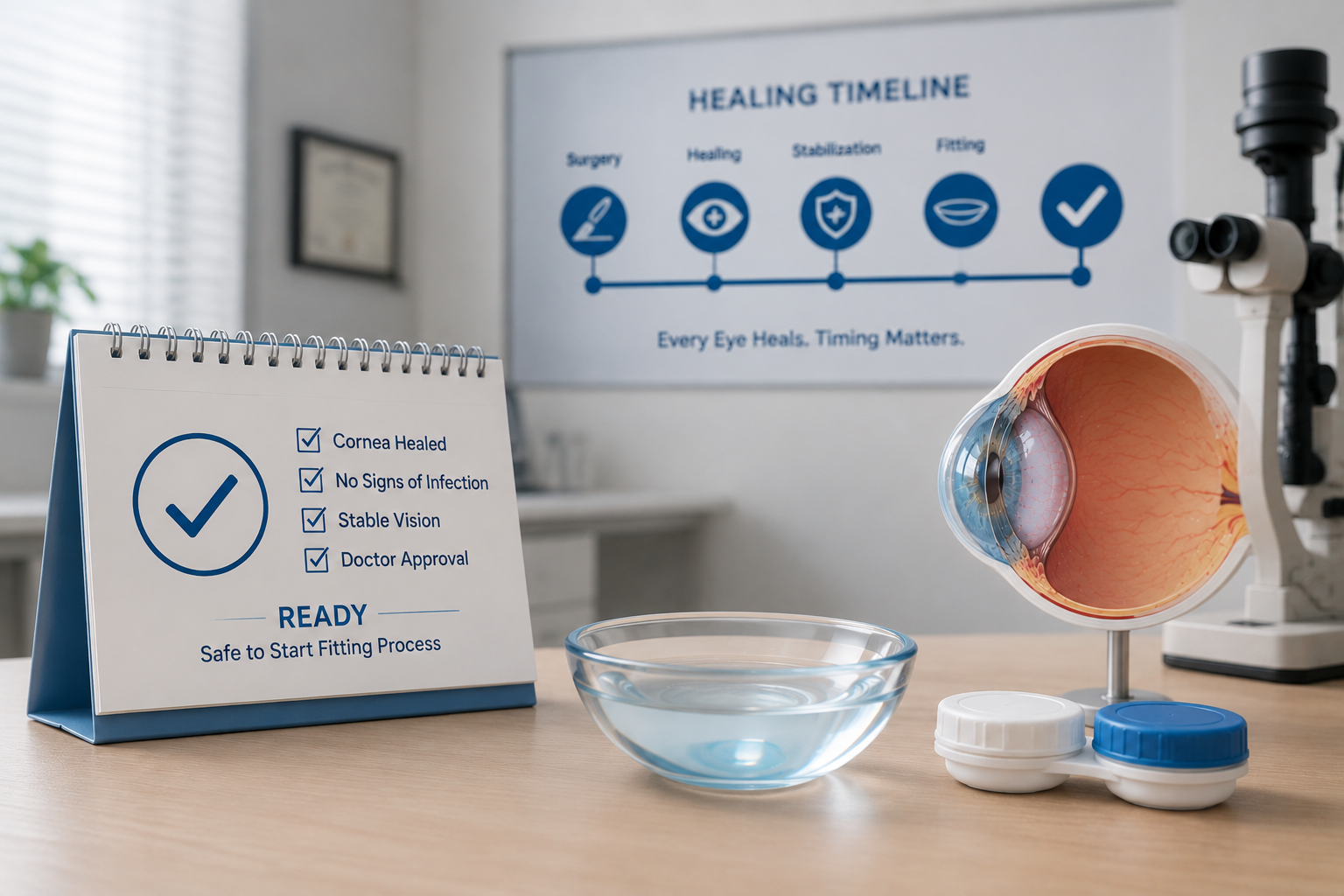
Most patients can begin the fitting process 3 to 6 months after surgery, ideally after sutures are removed.
Endothelial cell count matters: a count below 800 cells/mm² signals elevated risk for corneal edema during lens wear.
Multiple fittings may be necessary as the corneal shape continues to shift following suture removal.
Texas Contact Lens Institute offers free specialty lens consultations for post-transplant patients in the Plano, TX area.
About 85 to 90 percent of corneal transplants restore useful vision, and scleral lenses help patients reach the upper end of that range.
Why Post-Transplant Eyes Are Difficult to Correct
A corneal transplant, whether a deep anterior lamellar keratoplasty (DALK) or a penetrating keratoplasty (PK), replaces diseased tissue with a healthy donor graft. The surgery itself is precise, but the healing process introduces new optical challenges. The graft-host junction creates an irregular surface that standard glasses and off-the-shelf soft contacts cannot fully correct.
Residual corneal astigmatism is the most common issue, and it is often severe and unpredictable in its orientation. Patients also frequently report significant dryness because the corneal nerves are disrupted during surgery, reducing the natural feedback loop that triggers tear production. According to Contact Lens Spectrum's clinical overview of post-transplant lens wear, these combined factors make specialty lenses, not conventional optics, the standard of care for this population.


How Scleral Lenses Work for Post-Transplant Eyes
Scleral lenses are large-diameter rigid lenses that rest on the white of the eye (the sclera) and completely vault over the cornea. That design matters enormously for transplant patients because the lens never contacts the graft or the graft-host junction. The reservoir of preservative-free saline trapped beneath the lens keeps the ocular surface lubricated throughout the day, which directly addresses the chronic dryness that follows surgery.
Optically, the smooth front surface of the lens replaces the irregular cornea as the primary refracting surface. This is why patients who saw 20/200 with glasses can often achieve 20/20 or near-20/20 with a properly fitted scleral lens. The Healio clinical blog on post-transplant contact lens options notes that scleral lenses are typically the first-choice recommendation when a graft has healed well, ahead of corneal RGP lenses or piggyback systems.
What the Fitting Process Looks Like
Fitting scleral lenses after a corneal transplant is not a single appointment. Here is what most patients go through:
Initial consultation: Corneal topography maps the surface; slit-lamp exam evaluates graft integrity and the junction zone.
Diagnostic fitting: Trial lenses are placed to assess vault height, limbal clearance, and lens alignment on the sclera.
Over-refraction: The prescribing power is dialed in over the diagnostic lens.
Order and delivery: A custom lens is manufactured and delivered, usually within one to three weeks.
Follow-up visits: Wear time is increased gradually; fluorescein patterns and corneal health are evaluated at each visit.
Multiple fitting sessions are common because the corneal shape continues to change as sutures are removed or break on their own. Patience during this phase pays off in a more stable, accurate final lens.
When Is It Safe to Start the Fitting Process?
Timing matters significantly. According to Modern Optometry's clinical article on scleral lenses for post-corneal transplant patients, the graft-host junction typically needs 3 to 6 months to heal sufficiently before lens fitting begins. Ideally, the fitting should wait until sutures are removed, because suture tension alters corneal curvature. A lens fit while sutures are in place may need to be completely redesigned once they come out.
Your cornea specialist will typically clear you for contact lens fitting. At that point, a referral to a specialty lens clinic, such as Texas Contact Lens Institute in Plano, TX, is the appropriate next step. The clinic accepts referrals by phone, email, or online form, and specialty lens consultations are offered at no charge.
Safety Considerations You Cannot Ignore
This is where post-transplant scleral lens wear differs from standard scleral lens fitting. The transplanted cornea has a compromised endothelium, the inner cell layer responsible for keeping the cornea clear by pumping out excess fluid. According to Weston Contact Lens's breakdown of scleral lens benefits after transplant, scleral lenses can cause a small amount of corneal edema even in healthy eyes during short wear periods.
In post-transplant eyes, that edema risk is higher and more variable. A transplanted cornea with an endothelial cell count below 800 cells/mm² is considered high risk for corneal edema and potential graft failure under lens wear. This threshold matters clinically, and any specialist fitting lenses on a post-transplant eye should have recent endothelial cell count data before proceeding. The NIH National Eye Institute provides broader context on corneal transplant health monitoring that patients and clinicians can reference.
Signs That Warrant Immediate Attention
Blurred vision after removing the lens that does not clear within 30 minutes
Persistent redness or discomfort during wear
Any sudden change in lens comfort or fit
If you experience any of these, stop wearing the lens and contact your eye care provider the same day.
Things to Know
About 85 to 90 percent of corneal transplants successfully restore useful vision, but the quality of that vision often depends on how well post-op optical correction is managed.
DALK and PK grafts create different surface profiles, so lens designs are not interchangeable between these two transplant types.
Preservative-free saline is non-negotiable for filling a scleral lens on a post-transplant eye. Preserved solutions introduce unnecessary chemical exposure to vulnerable tissue.
Even a well-fitted scleral lens needs to be re-evaluated if you have additional suture removal procedures, since each one changes the corneal shape.
Texas Contact Lens Institute operates by appointment only, Monday through Friday, 9:00 AM to 3:00 PM. Reaching out at (972) 299-8675 is the fastest way to schedule
Comparing Lens Options After Corneal Transplant
| Lens Type | Vaults Graft Junction | Corrects Irregular Astigmatism | Addresses Dryness | Comfort Level |
|---|---|---|---|---|
| Scleral Lens | Yes | Excellent | Yes, via saline reservoir | High |
| Corneal RGP | No | Good | Minimal | Moderate |
| Hybrid Lens | Partial | Good | Minimal | Moderate-High |
| Standard Soft Lens | No | Poor | No | Variable |
| Glasses | N/A | Limited | No | N/A |

Frequently Asked Questions

-
Most patients are ready to start the fitting process 3 to 6 months after surgery.
Waiting until the graft-host junction has healed and, ideally, until sutures have been removed gives the cornea time to stabilize. Fitting too early often means the lens will need to be redesigned as the shape continues to shift.
-
When properly fitted and monitored, scleral lenses do not contact or harm the graft.
The lens vaults entirely over the cornea, so there is no mechanical friction on the transplant or the junction. The main risk is corneal edema from oxygen restriction, which is why regular monitoring of endothelial cell count and corneal clarity is essential.
-
A referral is not strictly required, but your cornea surgeon's clearance is strongly recommended before starting.
At Texas Contact Lens Institute, referrals are accepted by phone, email, or online form, and the specialty lens consultation is free of charge. Most patients arrive having already been cleared by their transplant surgeon.
-
Most post-transplant patients require two to four fitting visits before a final lens is ordered.
Each visit fine-tunes the vault height, lens diameter, and prescription power. If sutures are removed between visits, an additional fitting session is likely needed.
-
Scleral lenses cannot prevent graft failure, but they do reduce mechanical stress on the transplant.
By vaulting over the graft and providing constant lubrication, they reduce the physical and desiccation-related stress that could contribute to graft compromise. They are a protective and corrective tool, not a substitute for medical monitoring.
The Bottom Line on Scleral Lenses After Corneal Transplant
If you have had a corneal transplant and your vision is still not where it should be with glasses alone, scleral lenses are almost certainly the most effective next step. They correct irregular astigmatism, protect the graft, and keep your eye comfortable throughout the day. The fitting process takes time and multiple visits, but the visual payoff is substantial.